The Importance of a Supportive Power Wheelchair
Jamie-Lee explains how her power wheelchair has become an essential part of daily life and emphasises the importance of finding the right occupational therapist (OT) to ensure assistive technology (AT) is tailored to individual needs.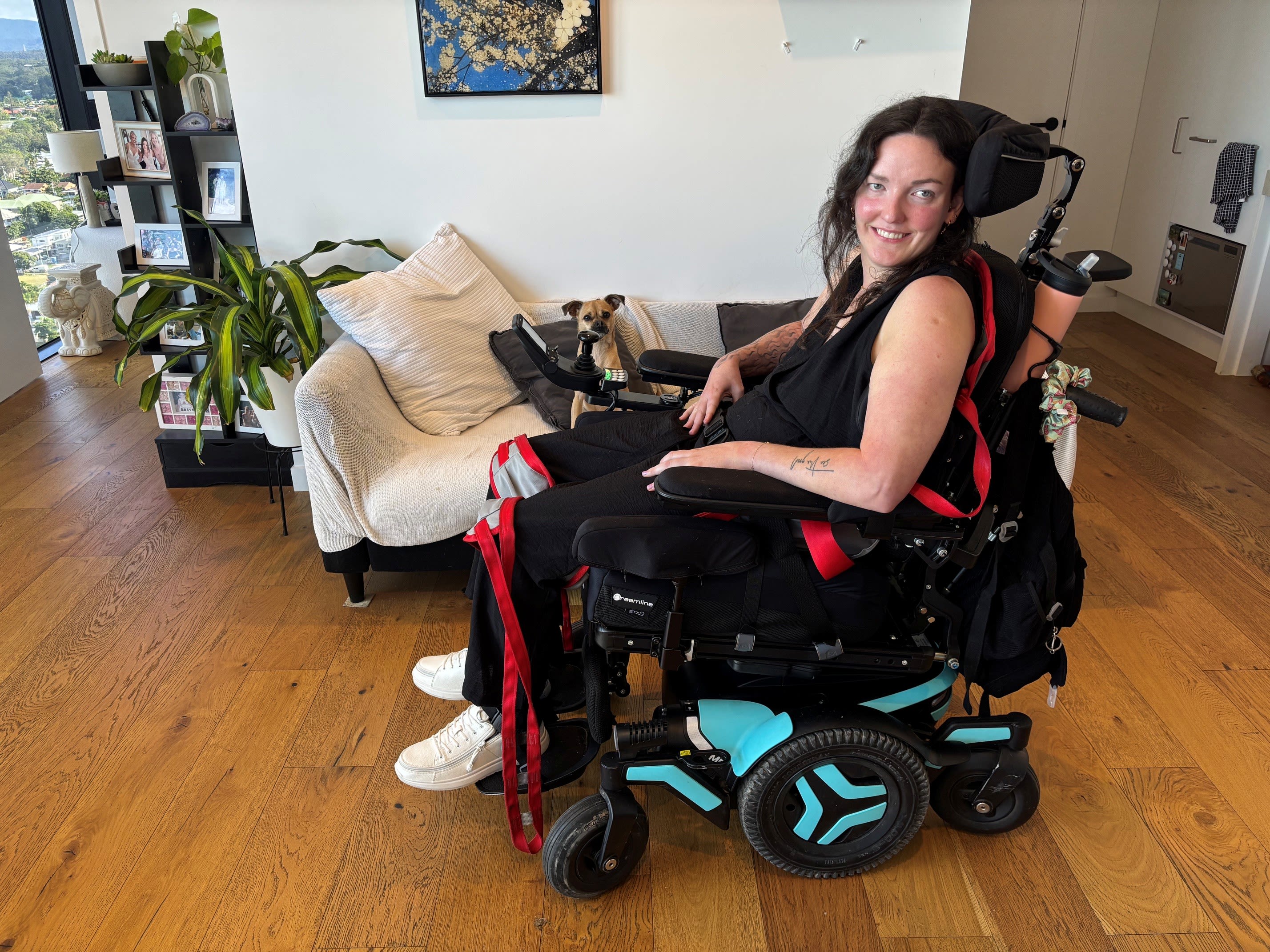 Jamie-Lee in her new power wheelchair. Only in my 30s did I begin using a power wheelchair full-time. Initially, I found power wheelchairs too big and confronting compared to manual chairs that are often smaller, weigh less, and are easier to transport. I started to experience pain and discomfort in the manual chair and needed more support to be transferred out of wheelchairs. It’s so important to be comfortable and supported when you are sitting in the same position for 16 hours a day.
Article published: July 2026



As someone with a progressive condition, I have used a lot of different forms of Assistive Technology (AT), but one of the most important is my power wheelchair.My power wheelchair is a crucial part of my life. It provides me with support and comfort, allowing me to change positions throughout the day depending on what I am doing. It’s the only piece of equipment I can withstand for long periods.My condition affects my back – I have scoliosis, which is a curvature of the spine. My power wheelchair is the only chair that alleviates my back pain through using the tilt functions. It also allows me to control the height, backrest, and footplates, and can go from a sitting to a lying position.
Transitioning to a Power Wheelchair
When I was walking, I used a walking frame to help me control the movement of my legs, which was hard to coordinate with my condition. My balance and how I moved were severely affected, so the frame gave me a lot more stability. All through my 20s, I used a manual wheelchair. If I wanted to go out with my friends, I could transfer to the front seat of their car and the manual chair was easy for my friend to fold down and put in the boot. Jamie-Lee in her new power wheelchair.
 Getting a New Power Wheelchair
I recently got a new power wheelchair. It took some time to get the NDIS funding approved and to trial a chair with my occupational therapist (OT) that would suit my needs. I noticed the difference between the new power wheelchair and my old one, which had deteriorated significantly since I got it in 2019. The average power wheelchair lasts between 5-7 years before the motor starts having issues. After a few years, the padding often breaks down and you lose support. It is important to have a skilled OT that can keep an eye on this to ensure you are sitting correctly and with enough support.Even after you have trialled your new power wheelchair with your supplier and OT, it’s not always obvious what further considerations need to be made. For example, the width of your armrests sometimes need to be moved in, to provide more support and your footplates may need to be adjusted for more stability. I prepared for these changes by purchasing some adhesive heat patches for my back as there is usually a physical adjustment period, but I immediately found the new chair more comfortable.Adjusting with AT
Getting a new power wheelchair is always difficult because there are often adjustments that need to be made to suit your individual needs. Due to my progressive condition, I no longer drive my own chair, which has been a massive adjustment for me and my support team. They have had to get used to the different steering, speed and larger size. During this adjustment period, some of my apartment walls got damaged which is sometimes inevitable, but frustrating because I can’t help.Final Thoughts
If you are looking for a new power wheelchair or manual wheelchair, you always need to be persistent about your individual needs and ensure you are heard. It’s very important to have a good OT behind you every step of the way as it makes your experience more seamless and tailored. A previous OT used to do a lot for me, and I really noticed the difference working with other people now. Having the right AT like a power wheelchair is important, but it is also worth investing your time and energy into finding the right OT to make sure these supports are working the best they can for you.Article published: July 2026
Browse Resources
Housing Seeker Profile
Creating a Housing Seeker Profile is a simple process which involves telling us what you are looking for and what is important to you.
Housing Roadmap
The Housing Hub has worked alongside people with disability to map out the stages of a housing journey and the information you need to know about when moving through each step.