Emergency Assistive Technology Provides Safety for People with Disability & Their Supporters
Jamie-Lee Dwyer shares a firsthand account of how a lack of emergency assistive technology (AT) in her SDA apartment left her unable to call for help when her support worker was injured, exposing serious safety concerns. She highlights the essential role this tech and the right support system play to ensure people with disability and their supporters are safe.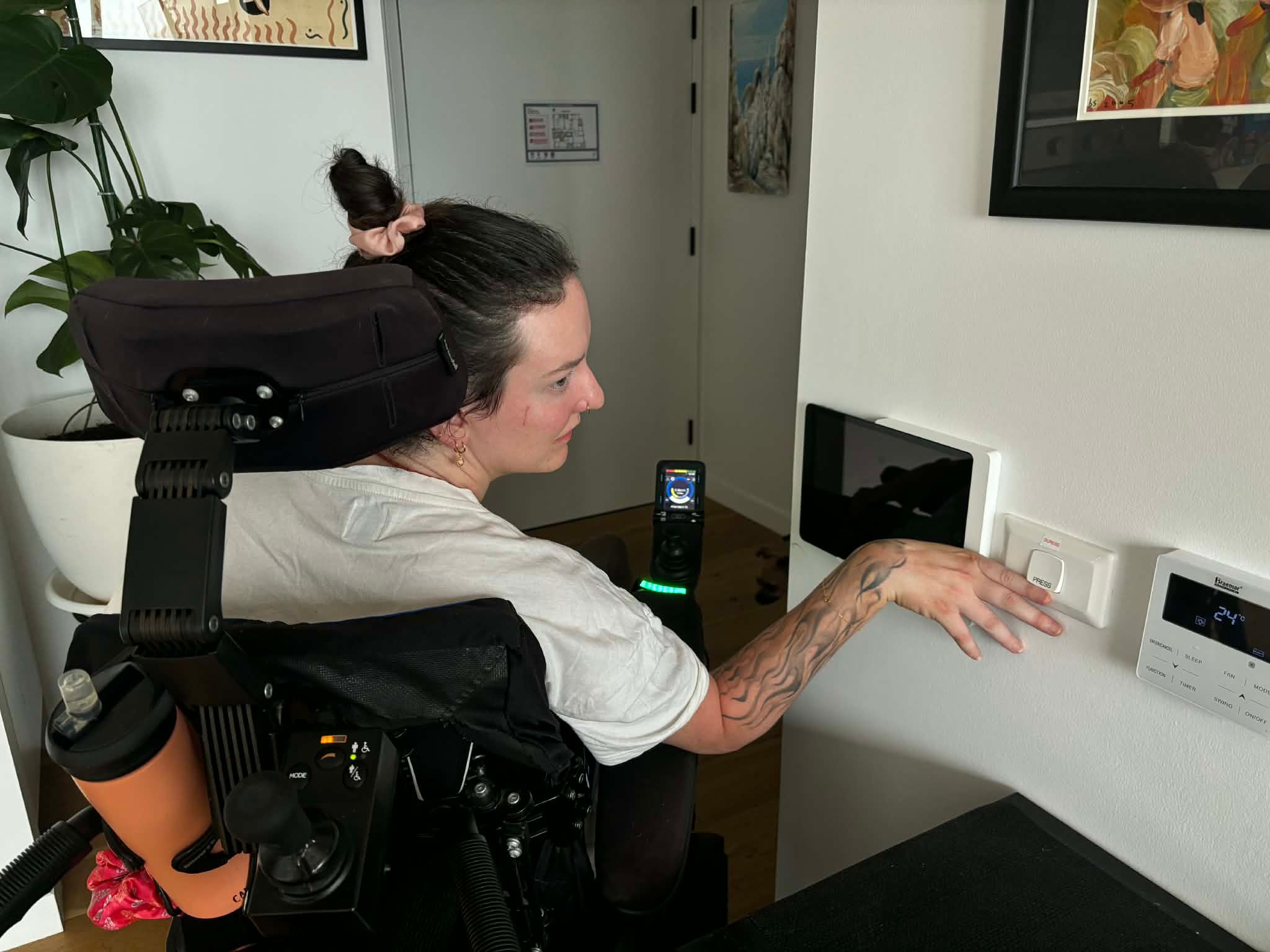 Jamie-Lee pressing the duress button in her apartment, which you need to hold for three seconds. She would not be able to physically get to the button on the wall without assistance.After my support worker’s injury, I followed up with the provider and landlord multiple times about installing emergency assistive technology. I thought actually having an incident occur in my apartment would make them more responsive, but disappointingly no action has been taken, nor have I received a response.I then told my current OT what had happened, and they thankfully are arranging another wrist pendant for me through the National Disability Insurance Agency (NDIS). However, due to a National Disability Insurance Agency (NDIA) review, it won’t be ready for a few months.I regret not telling my current OT what was going on earlier, because OTs are more familiar with individual needs and the AT that’s available.
 Article published: February 2026
The Housing Hub currently lists over 5,500 homes for people with disability. Search for a home that is right for you today!Or better still, create a Housing Seeker Profile and let the Housing Hub do the hard work for you. Sign up here!

When I first moved into my current Specialist Disability Accommodation (SDA) apartment building, I was told I would be provided with an emergency assistive technology (AT) pendant for safety reasons. However, after almost 12 months into my lease, I still haven't been given one.During the recent holiday break, my support worker injured herself quite badly in my home, right in front of my eyes. After the initial shock, it left me feeling quite traumatised and helpless, as there was nothing I could do for her.Due to my condition, I have limited control over movement in my limbs, and I’m unable to use AT like Siri or Voice Activation because of my speech impairment. In these instances, I couldn’t call anyone for help. I was in a very precarious situation, watching it all unfold.Thankfully, my support worker is okay now, but it made me wonder what I would have done if the situation were worse. How would I call for help, for my support workers, or myself if I were alone?At my previous SDA apartment, I had a wrist pendant which I wore at night, and when I was alone, so I could contact the concierge support desk. That was organised by my previous occupational therapist (OT).
 Jamie-Lee pressing the duress button in her apartment, which you need to hold for three seconds. She would not be able to physically get to the button on the wall without assistance.
In hindsight, I wish I pushed more firmly to get the AT installed before I moved in, instead of waiting until a safety issue occurred.
Advice for People with Disability:
Be more persistent with your housing provider about the importance of emergency AT and an emergency plan.- It helps to have a strong advocate to assist in communicating with the housing provider.
- Contact your OT, they have more experience with your needs and should be able to arrange emergency AT if required.
- Make sure you have enough funding for suitable AT.
- Contact Housing Hub’s Home and Living Support Coordination team for funding advice for these supports.
Advice for Supporters Who Injure Themselves While Providing Care:
- Check your Insurance policy is up to date with suitable cover.
- Ensure you have an emergency plan in place with the people you support.
- Provide your emergency contact list to the people you support and those heavily involved in their lives, if you feel comfortable doing so.
- In the event of an incident, stop working immediately and seek medical help.
- Tell your workplace as soon as possible, and lodge an Incident Report and/ or WorkCover claim.
- Document everything: the date, time, location, what happened, witnesses, and any treatment you received.
Need help securing the right funding?
Access our Home & Living Support Coordination Service. Enquire or refer todayPhone: 1300 322 013Email: specialists@housinghub.org.au
About The Author
Jamie-Lee loves to challenge stereotypes surrounding disability; her lived experience of growing up with a disability motivates her advocacy. Having studied journalism at university, she uses her writing skills to her advantage. She hopes to help other people with a disability along their journey, encouraging vulnerable people to find their voice. She believes that diversity will pave the way to equality for all.The Housing Hub currently lists over 5,500 homes for people with disability. Search for a home that is right for you today!Or better still, create a Housing Seeker Profile and let the Housing Hub do the hard work for you. Sign up here!
Browse Resources
Housing Seeker Profile
Creating a Housing Seeker Profile is a simple process which involves telling us what you are looking for and what is important to you.
Housing Roadmap
The Housing Hub has worked alongside people with disability to map out the stages of a housing journey and the information you need to know about when moving through each step.