Choice & Control: Why SDA Tenant Advisory Committees Are Vital
Jamie-Lee uses her lived experience to argue that Tenant Advisory Committees should be an essential part of Supported Disability Accommodation because they give tenants real choice, control, and accountability over their onsite shared supports.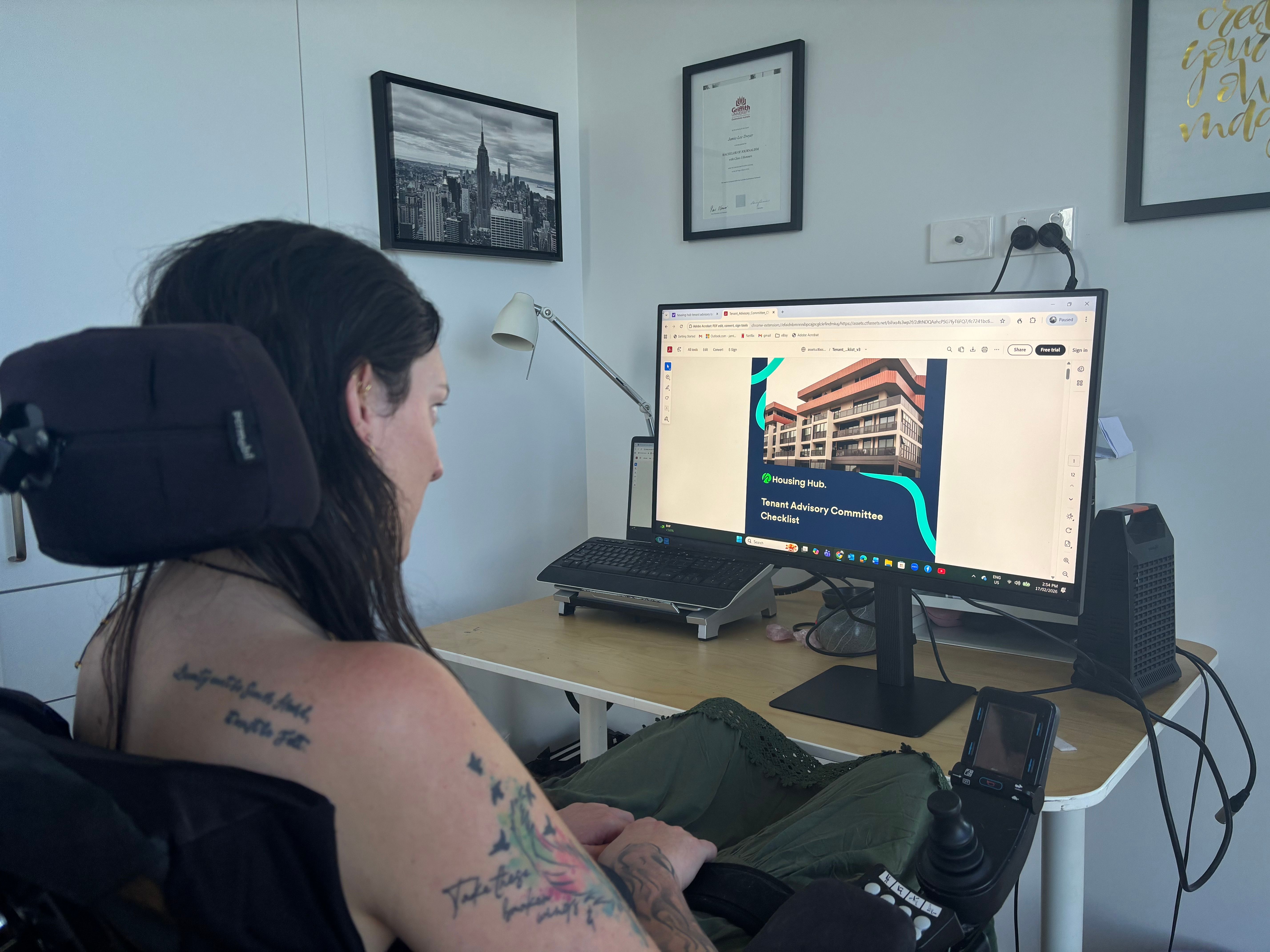 Jamie-Lee accessing the Housing Hub Tenant Advisory Committee resources.
 Article published: February 2026
The Housing Hub currently lists over 5,500 homes for people with disability. Search for a home that is right for you today!Or better still, create a Housing Seeker Profile and let the Housing Hub do the hard work for you. Sign up here!

My Experience with Tenant Advisory Committees
I’ve lived in multiple Supported Disability Accommodation (SDA) apartments and have come to realise the importance of there being a two-way conversation between tenants and housing providers when it comes to shared supports.There were 10 tenants at my previous SDA and we all voted yearly for which support provider would be providing Onsite Shared Support (OSS) as part of a Tenant Advisory Committee.A Tenant Advisory Committee is a formal setting where open communication between tenants and housing providers can happen. It is a regular opportunity for tenants and providers to co-create an environment where everyone is free to speak openly about their concerns and share what is working well. Having the contracts reviewed yearly meant the OSS provider did their best to keep the SDA tenants happy with their services. I have been living at my current SDA for nearly 12 months. There is no Tenant Advisory Committee, and the housing provider has not given us a chance to vote on the OSS provider. Jamie-Lee accessing the Housing Hub Tenant Advisory Committee resources.
 The Risks of Not Having a Voice
Without the yearly review process, there is no accountability to keep tenants satisfied. I think it’s important to give tenants the opportunity to be heard and listened to.My OSS provider doesn’t seem to train their staff in the tenant’s individual needs, manual handling or specific equipment. This has resulted in a couple of minor accidents, for example I use OSS services to assist with transferring into my standing frame. It helps if I have my shoulders supported, and if not, I can easily fall. I don’t hold this against the staff, more so it’s an issue with the support provider’s practices and the staff being unfamiliar with my equipment and needs. I’m trying to navigate this by asking my individual support team who are aware of my needs to fill in the gaps with the OSS, as it's difficult for me to explain my own needs with my speech impairment. I was also paired with a hearing impaired staff member who could not understand me which was distressing for both of us. Housing Hub has a section in our Solving Problems in NDIS Housing series called "How Should Shared Support Work?" which features videos and templates for both providers and tenants to better understand how shared supports should work in SDA.I’ve been in contact with both my housing provider and landlord and they confirmed that SDA tenants living here don’t have a say on the OSS provider. I wish I checked the contract regarding a Tenant Advisory Committee before I moved in, but I just assumed it would be regular practice. Housing Hub has a resource which is helpful for tenants to know their rights when they aren't satisfied with their OSS provider.Tenant Advisory Committees Uphold Choice & Control
NDIS is all about choice and control and this should be implemented in all SDA properties. Now that I know having a say in the OSS is not regular practice, I think it’s important to give all SDA tenants choice and control about who provides this support. Looking to the future, I feel that if the NDIA does not mandate Tenant Advisory Committees at all shared SDA properties, it is not in line with choice and control policies that are meant to uphold the NDIS. Housing Hub has a checklist template on setting up a Tenant Advisory Committee, which is useful for both tenants and providers, making it easier to incorporate them into standard practice.Need help securing the right funding?
Access our Home & Living Support Coordination Service. Enquire or refer todayPhone: 1300 322 013Email: specialists@housinghub.org.au
About The Author
Jamie-Lee loves to challenge stereotypes surrounding disability; her lived experience of growing up with a disability motivates her advocacy. Having studied journalism at university, she uses her writing skills to her advantage. She hopes to help other people with a disability along their journey, encouraging vulnerable people to find their voice. She believes that diversity will pave the way to equality for all.The Housing Hub currently lists over 5,500 homes for people with disability. Search for a home that is right for you today!Or better still, create a Housing Seeker Profile and let the Housing Hub do the hard work for you. Sign up here!
Browse Resources
Housing Seeker Profile
Creating a Housing Seeker Profile is a simple process which involves telling us what you are looking for and what is important to you.
Housing Roadmap
The Housing Hub has worked alongside people with disability to map out the stages of a housing journey and the information you need to know about when moving through each step.